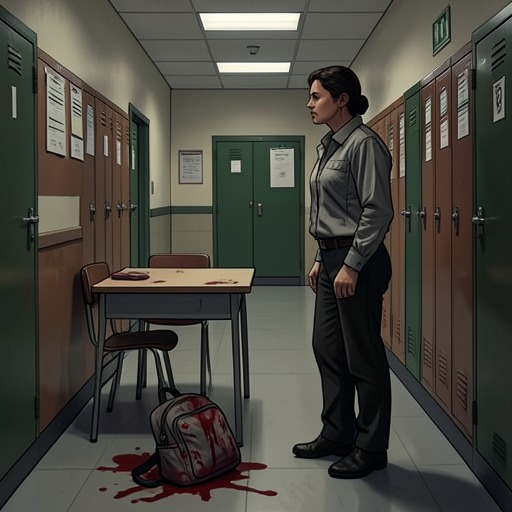
Matt Kellner’s backpack
The ShardsMatt Kellner’s backpack is the first concrete object to connect his disappearance with a possible death. Found bloodstained in a parking lot at Crystal Cove State Park, it bears an identification tag with his name and address. The evidence makes the bag a grim clue, but not a reliable explanation: later mileage information shows that Matt’s Datsun could not have taken him there, while the official account of his death rests on a chain of assumptions that his father and Bret Ellis struggle to reconcile with what they know.
Discovery and Identification
A ranger found the backpack in a parking lot above a bluff overlooking the ocean. The Orange County Police were alerted because blood covered it; the name and address on its small identification tag matched the missing-person report filed by Matt’s parents, Ron and Sheila Kellner. The bag thus became the first reported physical evidence in the search to tie Matt to a specific place after he vanished.
By the time the discovery was relayed to Buckley, Matt had been missing for several days. Susan Reynolds told the school assembly that he was still missing and asked anyone with information to contact the administration, promising confidentiality. She did not disclose the backpack’s blood to the students at large, on the advice of Dr. Croft, who considered the detail too upsetting, particularly for younger pupils. The school received a restrained public announcement while the adults held back the clue that had most sharply darkened the case.
A Location Without a Journey
The setting seemed to invite an immediate inference: Matt had gone to the coastal park, and something had happened there. When Ron Kellner later asked Bret Ellis what he knew about his son’s final week, Bret brought up the backpack and wondered aloud whether Matt had driven to Crystal Cove. Ron rejected the premise. He had noted the Datsun’s mileage when the car was serviced and checked it again after it was returned to the guesthouse garage; in the intervening week, the car had been driven barely ten miles. It could not have made the roughly 140-mile round trip to the park.
That contradiction changes what the backpack can establish. The tag and blood connect the object to Matt, and the report locates it at Crystal Cove State Park, but neither fact establishes that Matt drove there himself. Ron’s mileage comparison instead makes the bag’s presence difficult to place within the known movements of the Datsun. The object points to a location while the car’s recorded use denies the most straightforward route to it.
Blood, Photos, and the Official Account
The backpack’s blood takes on greater weight when considered alongside the later evidence Ron shows Bret. Crime-scene photographs depict Matt’s body and injuries, and Ron identifies blood on the front seat and dashboard of the Datsun. The authorities’ account, as Ron explains it, treats a cut to Matt’s arm as self-inflicted during a supposed psychotic episode. It proposes that drug use led to the episode and that Matt then fell into the pool and drowned. Ron presents this as the official story, not as a settled explanation he accepts without doubt.
The autopsy report adds another troubling detail: it records the largely undigested contents of Matt’s aquarium in his stomach. Bret knows the aquarium had been empty for weeks and that Matt did not know what had happened to the fish. The backpack itself does not resolve this conflict, but its blood joins a wider set of objects and observations—the car, the photographs, and the autopsy findings—that resist a simple reconstruction of Matt’s final days. The official account supplies a sequence; the evidence leaves gaps in how its elements fit together.
The Backpack’s Narrative Role
At school, the backpack prompts questions no one can answer: why Matt would have been at the park, whether he had injured himself, how much blood was present, what the bag contained, and where his car was. The group’s questions soon fall away, and the school day continues. For Bret, by contrast, the discovery signals the possible approach of a death that others have not yet acknowledged. The disparity makes the bag more than a clue: it measures the distance between public routine and private alarm.
The backpack also sharpens the novel’s uncertainty about evidence and storytelling. A named object with blood on it appears to offer a direct account—Matt went to Crystal Cove and was hurt—but the mileage evidence unsettles that account, and the official reconstruction of his death remains disputed. Its significance lies precisely in that limit: it proves a connection between Matt and the search, while refusing to explain who carried it to the park, how it got there, or what happened to Matt.